
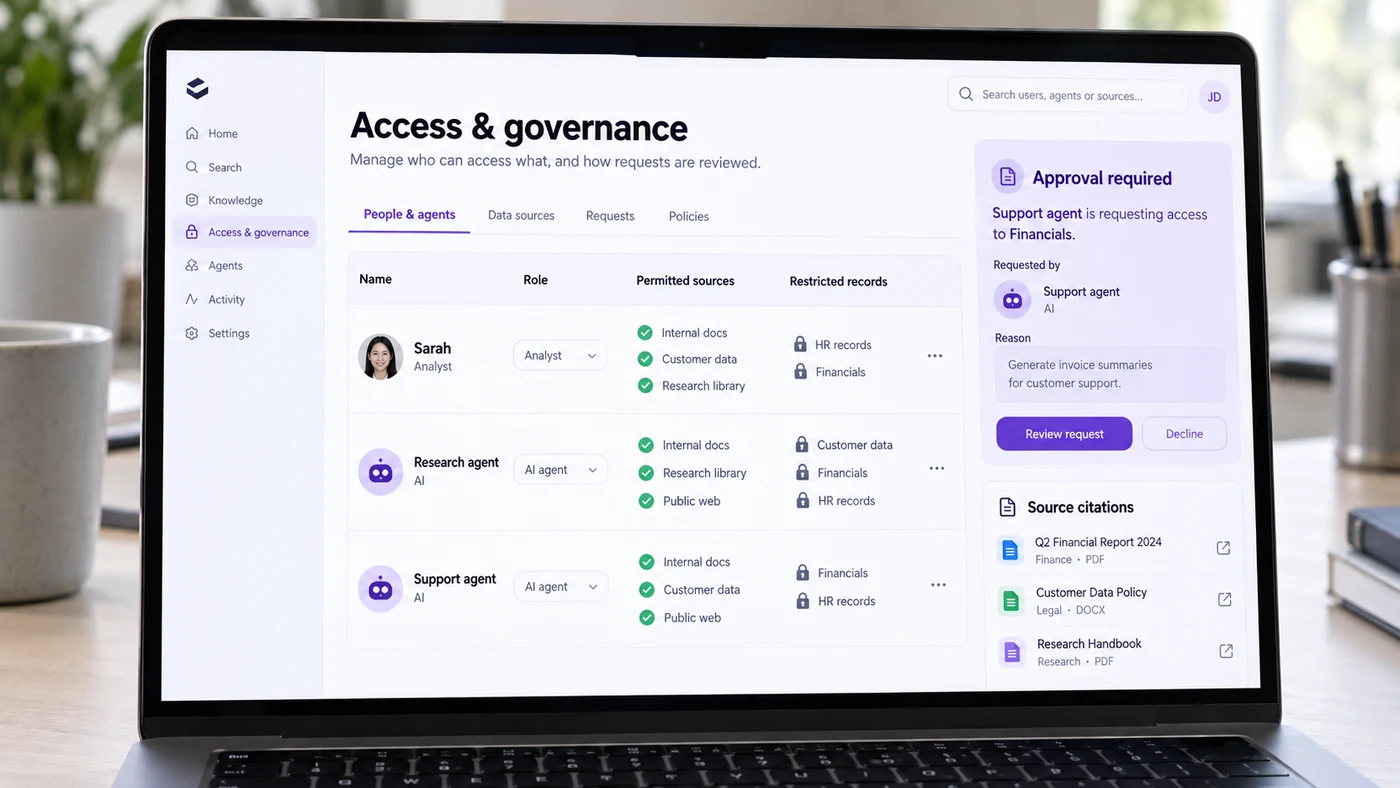
Giving an AI system access to more information is easy to describe. Giving it the right information, for the right person and the right task, is the harder design problem.
Govern access before generating an answer
An employee who can read a project plan may not be allowed to read its confidential commercial appendix. An agent working on that employee's behalf should not gain broader access simply because it uses a shared connection.
Authorisation needs to be enforced by the systems that retrieve data and execute tools. Instructions inside a prompt are not a substitute for access controls. Permission changes and deleted content also need a defined path through indexes and caches.
Preserve the evidence trail
A useful response should distinguish a statement taken from a source from an inference drawn across sources. It should provide enough source detail for a reader to check the important claims and identify stale or conflicting material.
A citation is not proof that an answer is correct. It is a route to verification. Evaluate whether the cited passage supports the claim, whether the source is authoritative for that question, and whether important qualifications were omitted.
Give agents a bounded task
An agent preparing a briefing may need to retrieve policies and summarise recent operational activity. It does not necessarily need permission to change those policies or update business records. Reading information and taking action should have separate boundaries.
For consequential actions, define which steps require human approval. Make the requested operation, target records, and expected effect visible before execution. Keep an audit trail that helps an operator understand what happened without unnecessarily recording sensitive content.
Make context smaller by making it relevant
Token efficiency means being selective about the evidence passed to a model. Relevant passages, useful metadata, and focused query results can be more effective than entire repositories. But aggressive compression can also remove exceptions that change the meaning of a rule.
Measure efficiency alongside answer quality. Compare token usage, response time, source coverage, and the rate of unsupported claims on representative tasks. A shorter answer path is valuable only if it preserves what the decision requires.
Cognx's emphasis on governed enterprise context reflects this balance: humans and AI agents need usable knowledge, while organisations need clarity about how it is accessed and applied. The governance design should be validated for each deployment.
The right context is relevant, traceable, current enough for the task, and within the requester's permissions.